| [1] |
Vlasic, B. and Boudette, N. (2016). A Tesla Driver Using Autopilot Dies in a Crash, The New York Times, July 1, 2016, p. A1. |
| [2] |
Norman, D. A. (1990). The Problem with automation: inappropriate feedback and interaction, not over-automation. Philosophical Transactions of the Royal Society of London, S. 585-593. |
| [3] |
Isaac Asimov (1950), I, Robot, novel. |
| [4] |
Parasuraman Raja, V. R. (1997). Humans and automation: Use, misuse, disuse, abuse. Human Factors: The Journal of the Human Factors and Ergonomics Society 39.2, S. 230-253. |
| [5] |
Payre, W. A. (2015). Fully Automated Driving Impact of Trust and Practice on Manual Control Recovery. Human Factors: The Journal of the Human Factors and Ergonomics Society. |
| [6] |
T. Helldin, G. F. (2013). Presenting system uncertainty in automotive UIs for supporting trust calibration in autonomous driving. Proceedings of AutomotiveUI 2013, ACM, S. 210-217. |
| [7] |
Boyle, D. A. (2009). Drivers' Understanding of Adaptive Cruise Control Limitations. Proceeding of the HFES Society Annual Meeting. |
| [8] |
Wintersberger, P., Frison, A.-K., Riener, A., Boyle, L. (2016). Towards a Personalized Trust Model for Highly Automated Driving. Proc. of Mensch und Computer, pp. 8. |
| [9] |
Fitts, P. M. (1951). Human engineering for an effective air navigation and traffic control system. National Research Council, Washington, DC. |
| [10] |
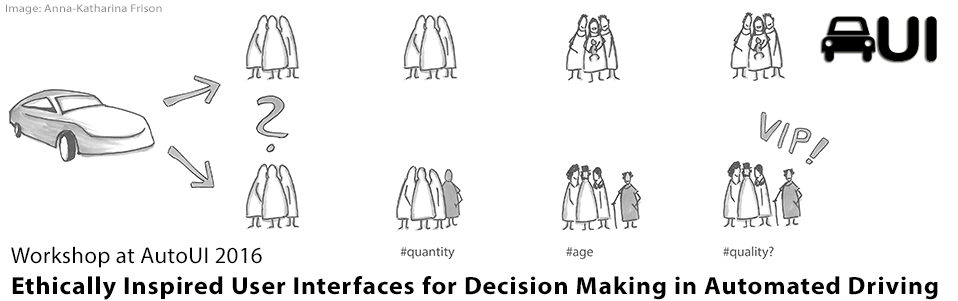
Bonnefon, J-F., Shariff A., Rahwan I. (2016). The social dilemma of autonomous vehicles, Science, Vol. 35, June 24, 2016, 10.1126/science.aaf2654. |